



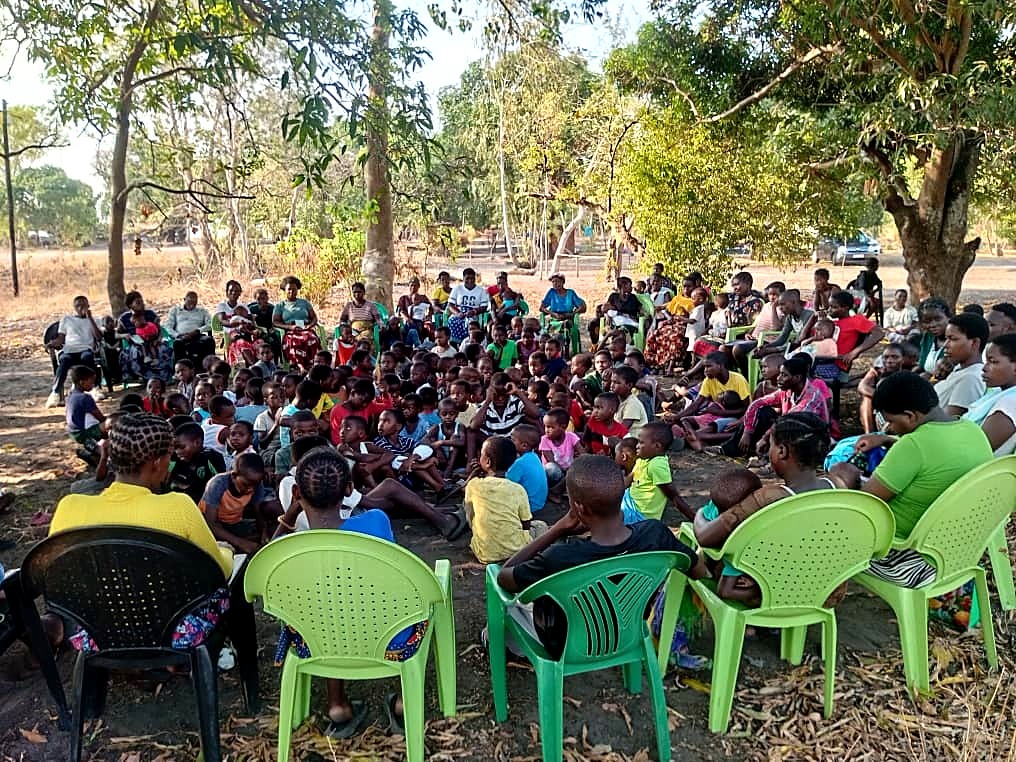
LILONGWE, Malawi, 16 November 2026 — Under mango trees, on blue tarpaulins spread across courtyards and in older brick buildings, communities across Malawi gathered this week to celebrate the Twin Holy Days: the Birth of the Báb on 10 November and the Birth of Bahá’u’lláh on 11 November.
On the morning of 10 November, the National Spiritual Assembly of the Bahá’ís of Malawi wrote to every community in the country, encouraging them to hold “befitting celebrations” for the Birth of the Báb and the Birth of Bahá’u’lláh that bring together children, junior youth, youth and adults. The Assembly described the two days as a special chance for Bahá’ís, their families, friends and the wider community to share in “prayer, fellowship, joy and spiritual reflection.” The Assembly’s letter adds: “These two sacred occasions hold profound significance in the Bahá’í Faith. [They] mark the advent of two Divine Manifestations whose teachings have brought renewed spiritual guidance, hope and unity to humanity.”
The two Holy Days fall on consecutive days each year. The Báb, born in Shiraz, Iran, in 1819, announced that a new Messenger of God would soon appear. Bahá’u’lláh, born in Tehran in 1817, is that Messenger and the Founder of the Bahá’í Faith. This year marks the 207th and 209th anniversaries of Their births.
Reports received from across Malawi paint a mosaic of lively celebrations. Most were not large, formal events. They took place close to home — in a neighbour’s yard, under a village tree, on a tarpaulin spread outside the house — and were arranged by the same people who meet each week for prayer, study and children’s classes. Friends, relatives and neighbours — all were warmly invited, and many came.
Children and dancing
In Kamadzi, a neighbourhood of Lilongwe, one household invited the children from their weekly children’s class, along with some of their parents. More than 30 children came, together with junior youth, five mothers and the eight members of the host family — over 40 people in all.
We said prayers together, shared briefly what the Bahá’í Faith is and who Bahá’u’lláh is, and that today is His birthday. We danced Chitelera — oh, how we love to dance this side! — and shared some refreshments. Happy Birthday, Bahá’u’lláh! Annie Banda, Kamadzi neighbourhood, Lilongwe

Friends with questions
Elsewhere, in Area 49 of Lilongwe, the celebration turned into a lively consultation. Someone asked a good question: why celebrate the Birth of Bahá’u’lláh on 11 November, when many books give the date as 12 November? The answer lies in the Badí’ calendar, which Bahá’ís around the world have used together since 2015. In this calendar the Twin Holy Days follow the moon: they fall on the first and second days after the eighth new moon following Naw-Rúz, the Bahá’í New Year. Their dates on the everyday calendar therefore move from year to year, usually between late October and mid-November. Bahá’u’lláh was born on 12 November 1817, which is why that date appears in many older texts.

A little to the southwest, in another neighbourhood of Lilongwe, 13 people gathered in a home for the Birth of the Báb. The group read and reflected on passages from the Bahá’í writings, and the hosts said the many questions raised by their guests made the session lively and helped everyone deepen their understanding. The afternoon ended with songs, food, conversation, and great excitement about continuing the celebrations the next day. One participant saw the gathering as a beginning rather than an end:
Beautiful and great. These Twin celebrations will create opportunities for more people to be connected to the Faith as we talk about the personages of the Báb and Bahá’u’lláh. Elube Mwendo, Lilongwe
And in another nearby neighbourhood, ten people — six adults, two youth and two children — met in a home on 11 November. They shared prayers, readings, songs and stories from the lives of the Báb and Bahá’u’lláh, and talked about how to apply Their teachings in daily life. Joyful gatherings were also held in Blantyre, in Chikapa village in the Thyolo area, and in Zomba.
For many participants, the Holy Days are a reminder of a message that is simple to state and demanding to live: that humanity is one family. Bahá’u’lláh wrote that the well-being of humanity, its peace and security, cannot be achieved unless its unity is firmly established. Gatherings like these — where neighbours pray, eat, dance and ask questions together — are one small way communities across Malawi are putting that principle into practice.


